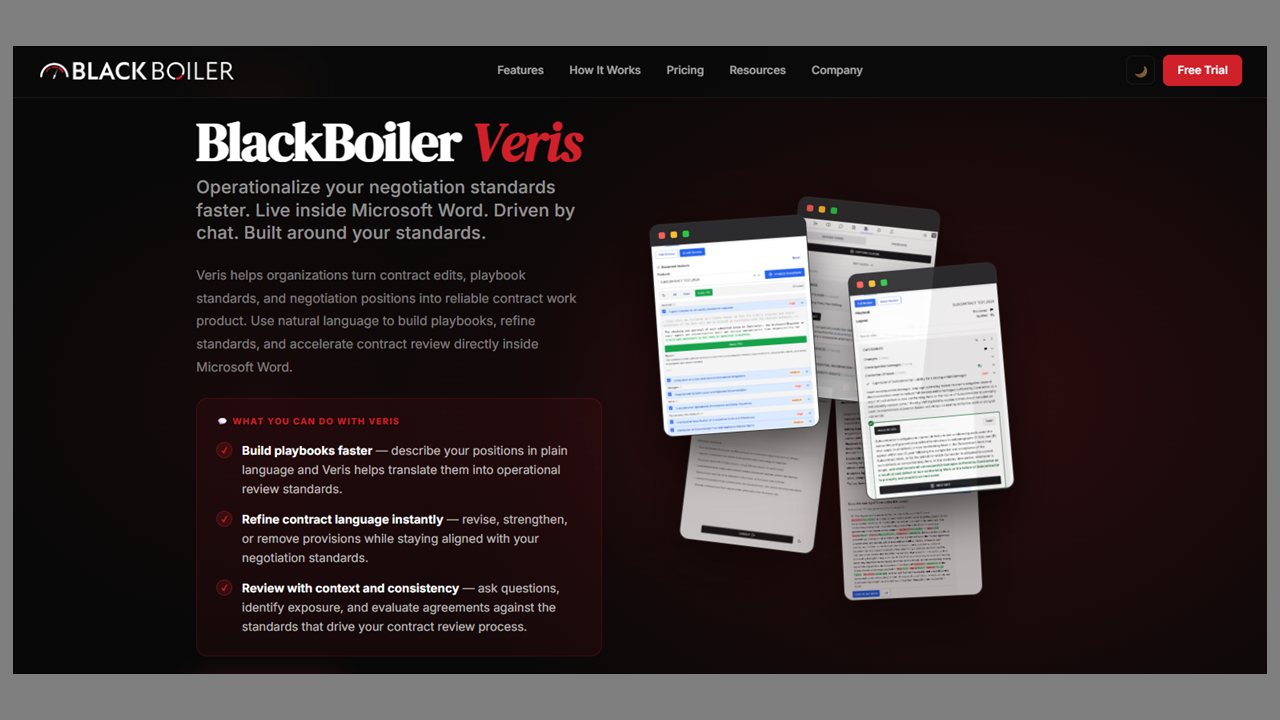
BlackBoilera company that has spent more than a decade developing automated redlining technology, this week launched Veris, a new platform that takes its original deterministic editing engine and powers it with generative AI and a chat-based agent interface.
Running directly within a Microsoft Word add-in, Veris allows contract review teams to negotiate and annotate agreements without ever leaving the document.
Alongside this launch, BlackBoiler is rolling out two new subscription tiers aimed at expanding its reach beyond its traditional enterprise base. The Starter level, designed for solo reviewers, costs $1,250 per year. The Pro tier, designed for recurring team assessments, costs $3,000 per user per year.
During a demonstration for LawSites, Daniel Broderickco-founder and CEO of BlackBoiler, said Veris was developed in response to recurring customer demand. While they like the accuracy and consistency of BlackBoiler’s data-driven editing, they want it to be delivered through a more interactive experience and with faster setup.
“They wanted this in a more agent-like experience with faster onboarding,” he said.
Combining two approaches
The original BlackBoiler system predates the current generation of large language models (LLMs). Instead of relying solely on predictive text, it uses an organization’s historical data (real examples of markups from past contracts) to drive its changes.
Veris maintains this deterministic foundation while incorporating LLMs “where necessary,” Broderick said. It includes strict controls on the data sent to the models, supported by a robust validation layer to verify the results.
This validation process is a core functionality of Veris. The system statistically analyzes each suggested edit, measuring the magnitude of a sentence’s changes and tracking additions or deletions of specific words. It then cross-references these changes with similar changes that BlackBoiler has processed in the past.
The goal is to limit hallucinations and “only change what needs to be changed and no more than what needs to be changed,” Broderick said.
Robert MooreBlackBoiler’s sales director, said determinism is what sets Veris’ approach apart from using an LLM alone.
He noted that two people giving the same input to a general-purpose model may receive different outputs, whereas Veris bases changes on a company’s own standard. A “judge” component validates a suggested change by tracing it back to examples provided by a customer.
Automating Playbook Configuration
The faster integration enabled by Veris comes largely from its ability to automate the work of creating a playbook – the primary set of rules that govern how an organization wants contracts to be modified. Broderick said the company has automated a curation step that previously required participation from humans employed by BlackBoiler.
In the demo, Broderick created a playbook by downloading a single tagged contract and asking the system to extract the rules. Users can also do this by uploading a policy document or written description of how they want to manage specific risks, or they can simply describe a rule directly.
In the demo, Veris extracted about 20 rules from the sample document, displayed the corresponding rules from BlackBoiler’s core rule libraries where they existed, and let the user accept, reject, or review each one.
From there, Veris runs an “enhancement loop” entirely in the background. For each rule, Veris:
- Generates a prompt and a corresponding judge.
- Search the BlackBoiler database for similar clauses.
- Applies the prompt to modify these clauses.
- Use the judge to evaluate the results on several examples.
- Automatically refines the prompt and judges it.
This approach, Broderick said, removes the human variable from rapid engineering. Since different lawyers inevitably write different prompts and get different results, Veris relies on the principle that “the data should create the prompts.”
Users can download up to 20 contracts through the app, it said, with larger volumes processed offline to avoid wait times. Incentivization and evaluation can be run on BlackBoiler’s data or a customer’s own data.
Two review modes
Veris offers two ways to review a document, reflecting the different ways users prefer to work.
A “full review” inserts all suggested changes directly into the contract as tracked changes. Broderick said this is suitable for intake-focused pipelines in which a document goes to an attorney already annotated.
A “quick review” places suggested revisions in the margin so the user can insert them one by one, ordered either by document position or risk level.
Users can also interact with a document through a chat interface, such as asking it to change the current law in a particular state, and can save these instructions as new rules in the playbook on the fly. Playbooks can be extended to an entire organization or specific users, depending on access.
Conclusion
When it comes to legal adoption of AI, validation remains a major hurdle. BlackBoiler says Veris is designed to directly address this problem, combining the creative power of AI generation capabilities with a deterministic layer to provide constraints and controls.
“Instead of relying on the nudging skills of each user, Veris derives nudging standards from the edit and review behaviors that define how an organization negotiates,” Broderick said.
Because the product uses the same historical basis to evaluate generated text before it becomes a final product, Broderick believes Veris represents the direction the industry is going.
“The next phase of contract AI will be shaped by consistency, governance and cost-effective execution,” he said, “not just language generation.”